
 0MY CART
 0
Lug Nut Guide: Sizes, Seat Types & Torque Specs Chart
July 5, 2026
The Complete Lug Nut Guide: Sizes, Seat Types & Torque Specs
Updated July 2026 · Originally published Jul 2021Buying lug nuts comes down to two things: size (your stud's thread diameter and pitch — e.g. M14x1.5) and seat (the shape where the nut meets the wheel — conical, ball, or flat/mag). Most aftermarket wheels take conical (60°) seat lug nuts — and yes, “acorn” and “conical” are the same thing. Torque them in a star pattern to your vehicle's spec (typically 76–100 lb-ft for cars, 130–150 lb-ft for half-ton trucks) and re-torque after 50–100 miles.
Nearly every aftermarket wheel needs aftermarket lug nuts — factory nuts almost never match the seat machined into your new wheels, and running the wrong seat is how wheels come loose. Ten minutes here saves you a wobble on the highway: what the sizes mean, which seat your wheels need, what your make uses, and how tight is actually tight enough.
What's In This Guide
- Size vs Seat
- The 3 Seat Types
- Thread Sizes by Make
- Torque Specs & How-To
- The 7 Lug Nut Types
- Steel vs Aluminum
- FAQ
Size vs Seat: The Two Things That Matter
Size is the thread specification of your wheel studs — a diameter and a pitch. “M14x1.5” means a 14mm-diameter stud with 1.5mm between threads. The lug nut must match the stud exactly; close doesn't count, and forcing a near-miss (say, M14x1.5 onto an M14x2.0 stud) destroys the threads.
Seat is the shape of the surface where the nut contacts the wheel. The wheel decides this, not the car: your new wheels are machined for one specific seat, and the nut must match it to center the wheel and hold torque.

The 3 Seat Types (and the Acorn Question, Answered)
Conical seat (acorn)
A beveled 60° taper that self-centers the wheel as you tighten — the standard for the vast majority of aftermarket wheels and the easiest to install correctly.
Ball seat (spherical)
A rounded, inverted-bowl contact surface. Common on European vehicles (Mercedes, VW, Audi — often as lug bolts rather than nuts) and on factory Honda wheels. Ball and conical look deceptively similar side by side; mixing them up means the fastener contacts the wheel on an edge instead of a surface, and it will loosen. When in doubt, check the wheel's spec sheet.
Flat / mag seat
A flat contact surface using a washer — either separate (mag seat, with an extended thread shank) or built-in (flat seat). Factory Toyota/Lexus alloys commonly use flat-seat nuts with washers; that's why moving to aftermarket wheels on those cars almost always means switching to conical nuts.
Lug Nut Thread Sizes by Make
The most common thread specs by manufacturer. Always confirm against your owner's manual or door-jamb sticker — especially near a changeover year:
| Make | Common Thread | Notes |
|---|---|---|
| Toyota / Lexus | M12x1.5 | 2022+ Tundra moved to M14x1.5 |
| Honda / Acura | M12x1.5 | Factory wheels use ball seat — aftermarket needs conical |
| Nissan / Infiniti | M12x1.25 | Finer pitch than Toyota — not interchangeable |
| Subaru | M12x1.25 | |
| Hyundai / Kia | M12x1.5 | |
| Ford cars / small SUVs | M12x1.5 | |
| Ford F-150 | M14x1.5 (2015+) | 2004–2014: M14x2.0 — see the 12th-gen guide |
| Chevy / GMC 1500 | M14x1.5 | |
| Ram 1500 | M14x1.5 (2012+) | 2009–2011: 9/16″-18 — see the 4th-gen guide |
| Jeep Wrangler | 1/2″-20 (JK) · M14x1.5 (JL/JT) | Changed with the 2018 JL |
| VW / Audi / Mercedes / BMW | M14x1.5 or M12/M14 bolts | Most use lug bolts, often ball seat — verify per model |
Torque Specs: How Tight Is Tight Enough?
Under-torqued lug nuts loosen; over-torqued ones stretch studs and warp rotors. The fix for both is a torque wrench and your vehicle's actual spec:
| Vehicle Class | Typical Torque | Examples |
|---|---|---|
| Passenger cars | 76–100 lb-ft | Lexus IS: 76 · most Hondas/Toyotas: ~80 |
| Midsize trucks / SUVs | ~85–110 lb-ft | Tacoma, Ranger, Colorado class |
| Half-ton trucks | 130–150 lb-ft | Ram 1500: 130 · Silverado 1500: ~140 · F-150: 150 |
| HD trucks (8-lug) | 140–165+ lb-ft | Check your manual — specs vary widely |
The right way to torque a wheel
- Hand-thread every nut first — if one won't spin on by hand, the thread is wrong or damaged. Stop.
- Snug them lightly in a star (criss-cross) pattern, never around the circle.
- Lower the vehicle so the tire just touches, then torque to spec in the same star pattern with a torque wrench.
- Never use an impact gun for final tightening — it's how studs get stretched and rotors get warped.
- Re-torque after 50–100 miles. Wheel and hub surfaces settle under load; a quick recheck is standard practice on every new install.
The 7 Types of Lug Nuts
1Conical (Acorn)
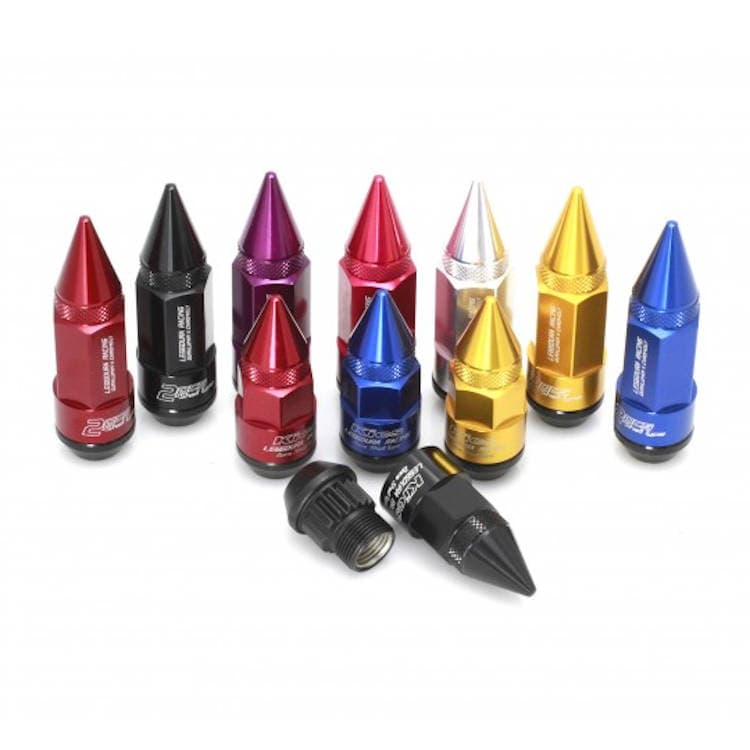
The aftermarket standard: 60° taper, self-centering, easy to install. Available open or closed-ended, long or short — check your wheel's cap design so the lug style doesn't block the center cap from seating.
2Ball Seat (Spherical)
Matches ball-shaped seats found on many European wheels and factory Honda alloys. Installs as easily as a conical — just don't confuse the two; the seat shapes are not compatible.
3Mag Seat
Flat washer seat with an extended thread shank. A relic of early aluminum-wheel days — still specified on some wheels, but rare in the modern aftermarket.
4Flat Seat
Like the mag but with the washer built in and no extended shank. Common on factory Toyota/Lexus alloys and some heavy-duty and industrial applications.
5Extended Thread (ET)
A conical seat with an added shank for deeper thread engagement on longer studs. More grip during install, more security on the road — a favorite for lifted trucks running spacers or long studs.
6Spline Drive (Tuner)
Slim-bodied lugs with a splined exterior that needs a special key socket. Designed for wheels with small, deep lug holes where a standard hex socket won't fit — common on tuner-style car wheels. Keep the key in your glovebox, not your toolbox at home.
7Locking Lug Nuts
One security lug per wheel with a unique key pattern — cheap insurance if you're running wheels worth stealing. Same rule as splines: the key lives in the vehicle, and losing it turns a tire rotation into a locksmith visit.
Steel vs Aluminum Lug Nuts
Colored aluminum lugs look fantastic and weigh nothing — but aluminum is softer than the steel stud it threads onto. Rounded corners, stripped threads, and seized galvanic corrosion are all more common with aluminum lugs, especially with repeated removal or impact-gun abuse. Our honest guidance: steel (chrome, black chrome, or coated) for daily drivers and anything that tows; aluminum for show builds that see careful hand-tool installs. If you love the anodized look on a daily, budget to replace them more often and always torque by hand.
Frequently Asked Questions
Are acorn and conical lug nuts the same thing?
Yes. “Acorn” is the informal name and “conical” the technical one for the same 60° tapered-seat lug nut — the most common style for aftermarket wheels. Ball (spherical) seat lugs are the ones that differ, with a rounded contact surface used mostly on European and factory Honda wheels.
What size lug nuts do I need?
Match the thread to your studs (see the chart above — e.g. M14x1.5 for a 2015+ F-150, M12x1.25 for most Nissans/Subarus) and match the seat to your wheels (conical for nearly all aftermarket wheels). Both must be right; either one wrong is a safety problem.
Can I reuse my factory lug nuts on aftermarket wheels?
Usually not. Factory nuts often use flat or ball seats (and two-piece designs) that don't match the conical seats machined into aftermarket wheels. A mismatched seat contacts on an edge instead of a surface and will loosen over time. Budget a proper conical set with the wheels.
How tight should lug nuts be?
To your vehicle's published spec, with a torque wrench, in a star pattern — roughly 76–100 lb-ft for cars and 130–150 lb-ft for half-ton trucks (F-150: 150; Ram 1500: 130). Never final-tighten with an impact gun, and re-torque after 50–100 miles on any fresh install.
Why won't a socket fit my old lug nuts anymore?
Swollen lug nuts — a chronic issue on two-piece factory nuts (notoriously 2004–2014 Fords). Moisture gets between the chrome cap and steel core, corrosion expands the cap, and your socket no longer seats. Replace them with one-piece aftermarket lug nuts and the problem never returns.
What's a lug bolt?
Many European cars (VW, Audi, BMW, Mercedes) skip studs entirely — the wheel is held by bolts that thread into the hub. Same seat-matching rules apply, and swapping to aftermarket wheels on these cars sometimes calls for different-length bolts. Check the wheel manufacturer's spec.
Thread and torque data verified July 2026 against manufacturer specifications. Always confirm your exact spec in your owner's manual — changeover years vary by model.


